I’ve been practicing yoga asana for more than 20 years and I credit this daily habit with keeping my body strong, limber and pain-free.
One of the fundamental truisms of yoga practice, after all, is that progress on the path toward liberation requires a robust body, because our body is the sole vehicle through which we experience yoga’s greatest treasures.
Liberation, however–at least in a yogic sense–isn’t the goal for most of us. Most people just want to stay flexible and strong as we age, and to maintain good health for as long as possible.
I’m firmly in this camp.
I’ve been picking apart various aspects of my physical yoga practice recently and either staying longer in particular poses or practicing them at various points throughout the day, a habit I refer to as “yoga snacking.”
The humble squat has become a favorite–and I’m making a conscious effort to squat whenever possible–whether watering plants, tying my shoes, working on my computer or folding laundry. This has not only made the pose more comfortable but has vastly increased the strength and flexibility of my spine, legs and feet.
In fact I’m now making it a habit to squat twice a day for five minutes–in addition to squats and other hip openers that comprise my daily yoga practice.
Just what makes squatting so damn good for us, anyway? According to yoga instructor Claire Grieve, daily squatting “enhances both strength and flexibility, along with providing a release of tension in the muscles and stuck energy and stress in your lower body.”
Squatting improves mobility in all areas of the body but most especially in the hips and knees, making it far easier to perform everyday activities like standing, sitting and bending. Win, win, win.
Let’s look at the specific areas of the body that are strengthened immeasurably by squatting:
Glutes. Our glutes love squats. A slow, controlled descent recruits all lower body muscles but especially the glutes, which are also stretched once we’re in the pose. Glutes weaken (and shrink) considerably as we age and the squat is ideal for keeping them firm and limber.
Quadriceps. The strength of the four hip flexors of the front thigh is essential to healthy aging. We use our quads every day to get in and out of the car, to sit (and stand) and to get up off the floor. Daily squatting charges and stretches these muscles in equal measure.
Hamstrings. As I age in yoga I see a familiar pattern: those with tight hammies–the three hip extenders on the back of the thigh–are at much higher risk for back pain. The reason? Tight hamstrings tug at the low back and pull the curve out of our lumbar spine, which stresses the vertebrae, as well as the sacrum, and can lead to pain.
Pelvic Floor. Squatting has been shown to strengthen the pelvic floor, which supports the bladder, bowel and uterus. Our pelvic floor weakens as we age–and is further stressed by pregnancy and childbirth, obesity, prostate cancer treatment and constipation. A strong pelvic floor is essential for healthy aging, and the squat targets this area marvelously.
And if increased strength and flexibility in these areas isn’t enough, the squat may also significantly reduce our stress and anxiety.
An August 2018 study in Integrative Medicine: A Clinician’s Journal found a connection between a healthy gut and stress, as 95 percent of serotonin (a hormone that affects mood and emotion) is found in our gut.
Because the squat helps promote normal function of our digestive system, it may also help promote a feeling of calm.
How to Squat
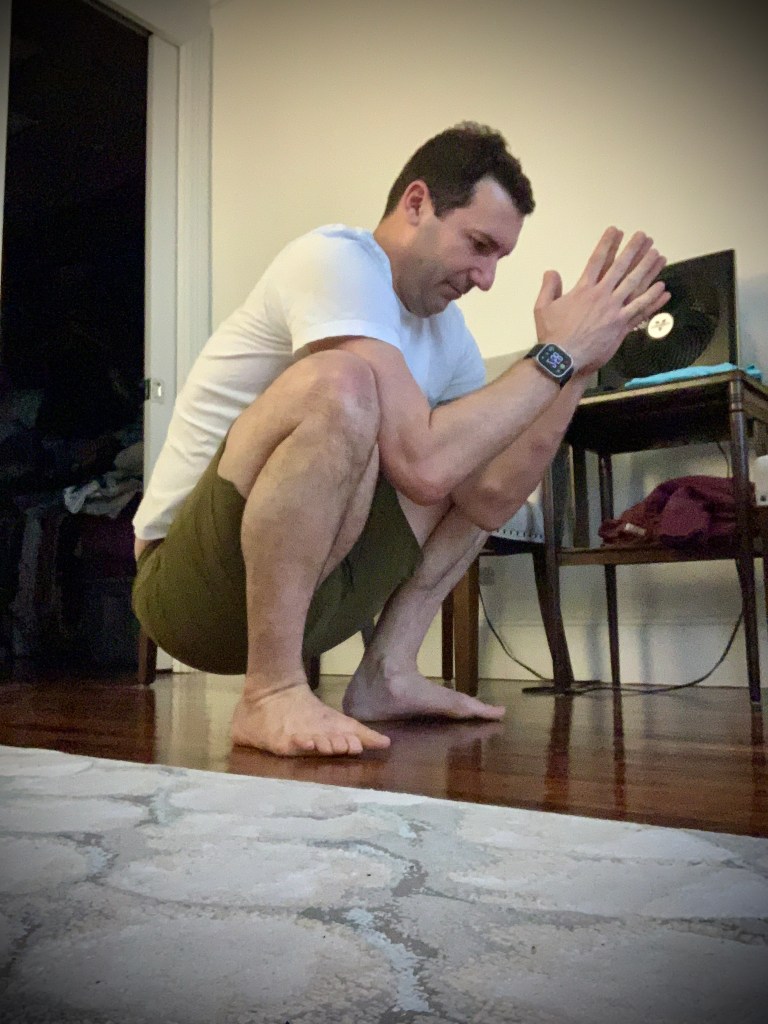
Squatting is considered a beginner-level yoga pose. Despite its significant health benefits, the pose is relatively easy and accessible for most people. Here’s how to do it:
- Stand with your feet wider than hip-width apart, with your toes slightly turned out.
- Bend your knees and come down into a full squat with your butt as close to the ground as your mobility allows.
- Once you’re in your full squat, take the time to adjust your feet and stance as needed. Try to keep your heels flat on the ground, but it’s OK if they come up slightly. You can also support your heals with a rolled up towel–or a folded-over yoga mat.
- Keep your torso straight as you bring your palms together and press your elbows into your knees to draw your legs apart.
- Keep your shoulders back and focus on lengthening through your spine.
- Think about reaching your tailbone toward your heels.
- Hold for 30 to 60 seconds. And as you get more comfortable with squatting try holding the pose for upwards of five minutes at a time.





 Chinese Medicine by Day
Leave a comment